
Earthbag retaining walls
Introduction to earthbag retaining walls
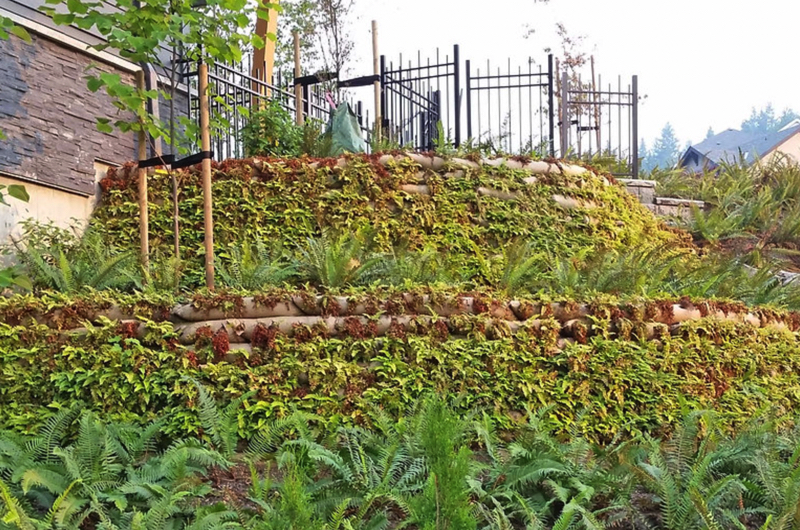
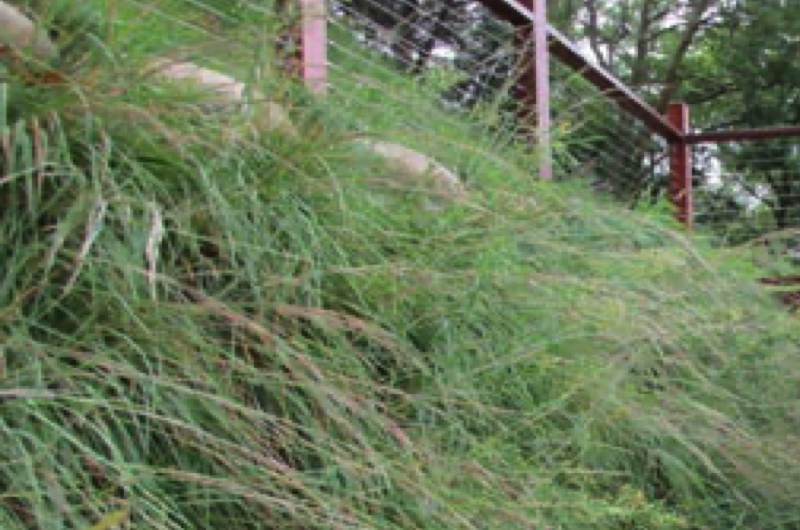
Earthbag retaining walls use synthetic fibre bags filled with sand and compost to create a retaining wall. The design is either gravity or geogrid-reinforced. Earthbags are ideal for permanent vegetative solutions.
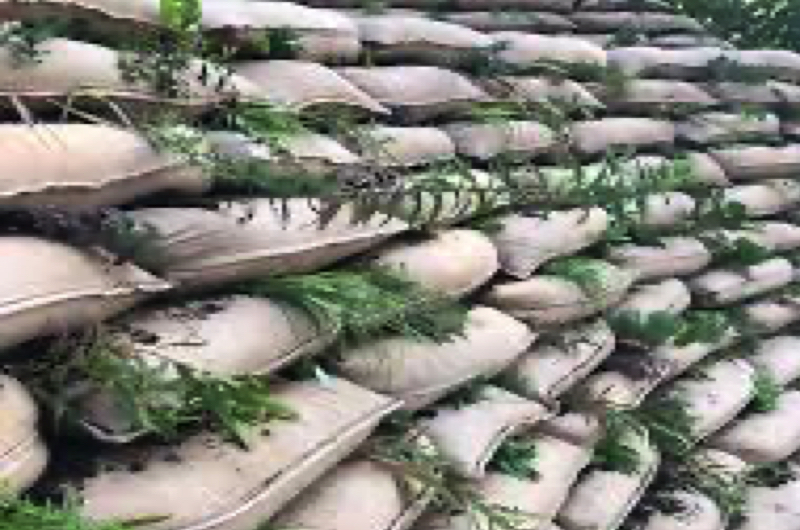
The earthbags are manufactured using a nonwoven geotextile produced by needle-punching together 100% synthetic staple fibres in a random network, forming a high-strength, dimensionally stable fabric. The Synthetic fibres are specially formulated to resist ultraviolet light deterioration and are inert to commonly encountered soil chemicals. The life span of the bags are 120 year when vegetated and 40 years when unvegetated.
Approximate earthbag sizes: length 660mm, width 380mm, height 140mm, volume 0.3 m3 and weight 38kg filled. Twelve bags are required per m2 for a standard stretcher bond and sixteen bags for a tie-back design.
Earthbag applications
Earthbags can be used for many applications, including:
- Vegetated gravity retaining walls up to 1.5m high
- Vegetated geogrid reinforced stone retaining have no height restrictions
- Timber criblock repairs
- River bank restoration and erosion protection
- Stormwater channels
- Culvert end walls
Earthbag design
For walls up to 1.5m high, a simple gravity design is the most economical. Wall heights over 1.5m require a stone geogrid reinforced backing.
Gravity design
The foundation is an MOT type 1 stone-filled trench; then the earthbags are laid to the structural design. The bags can be filled on-site or off-site, depending on the site constraints. The bags are filled with 60/80% sand and 40/20% compost. No height restrictions.
The geometry and mass of the wall prevent the wall from slipping and overturning.
Reinforced soil design
The foundation is similar to the gravity design.
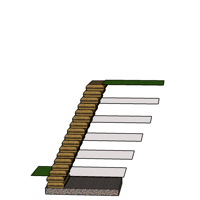
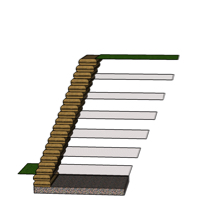
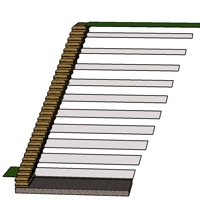
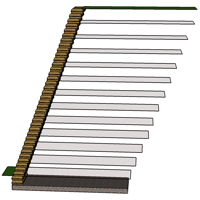
Geogrid reinforced stone, with a width of 80% of the wall height, acts as the structural retaining structure, with a face of earthbags. The earthbags are then seeded to create a green, vegetated wall surface.
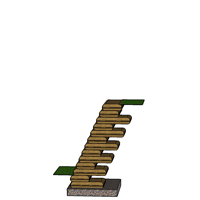
Earthbag retaining wall design guide
The design guide will give you an idea of the height of walls retaining rock can achieve. You can use it for budget purposes, but make sure you have your retaining wall designed by a structural engineer as there are many variables that need to be considered.
| Height (mm) | 1000 | 1500 | 2000 | 2500 | 3000 | 4000 | 5000 |
|---|---|---|---|---|---|---|---|
| Number of bag Courses | 9 | 13 | 17 | 20 | 24 | 31 | 38 |
| Bag Height (mm) | 140 | 140 | 140 | 140 | 140 | 140 | 140 |
| Base Width (mm) | 1000 | 1000 | 1600 | 2000 | 2400 | 3200 | 4000 |
| Base Depth (mm) | 150 | 150 | 150 | 150 | 150 | 150 | 150 |
| Geogrid Layers | N/A | N/A | 5 | 6 | 8 | 10 | 12 |
| Geogrid tail length (mm) | N/A | N/A | 1600 | 2000 | 2400 | 3200 | 4000 |
| Earthwall fill | N/A | N/A | Type 1 | Type 1 | Type 1 | Type 1 | Type 1 |
| Surcharge | 5kn/m² | 5kn/m² | 5kn/m² | 5kn/m² | 5kn/m² | 5kn/m² | 5kn/m² |
| Factor Of Safety | M=1.5 | M=1.5 | M=1.5 | M=1.5 | M=1.5 | M=1.5 | M=1.5 |
| Sketch | 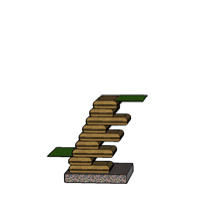 |
 |
 |
 |
 |
 |
 |
The design table above presents indicative designs based upon a base material with allowable bearing pressure of >200kPa.
The retained material is assumed to be well graded, granular backfill with the back of wall drainage or weep holes to relieve hydrostatic pressure. Fill used for the reinforced geogrid structure to be type 1 stone 40/50mm graded stone.
All indicative information presented in this table is based upon assumed loading and ground conditions. This table is for guidance purposes only and may be subject to change following a detailed, site-specific design developed by an approved structural engineer.
When we design your wall, we will consider the ground conditions, the retained material, the load cases and design the wall using the most cost-effective solution.
The purpose of the design guide is to allow us/you to develop a budget.
Prices
The fastest way to get a price for your project is complete the form below. Let us know if you just want bag prices or our complete service of design and supply.
Gallery of Earthbag retaining walls


Compare prices of retaining wall types
Which retaining wall type is the most economical to build? We have written a free guide on retaining wall price comparisons. The guide details the different types of retaining walls and gives you a price estimate of each type to compare.
Retaining wall price comparison guideRetaining wall design service
The design of a retaining wall requires knowledge of the retaining material, the water table, the ground bearing capacity and any site constraints. The design requires a ground investigation and a structural engineer to ensure the design is fit for purpose.
We offer a full design service from carrying out the ground investigation to final working drawings.
Learn about our retaining wall design serviceOther types of walls
FAQs about Earthbag retaining walls
The cost to build a earthbag retaining wall changes with the height of the wall, scale of project, location of the project and any site constraints.
We have designed a retaining wall price guide review the cost per m2 of all types to compare the prices Retaining wall price guide
Yes, every retaining wall is different, different loads, different ground conditions, different back fill and different site constraints.
We can design your retaining wall for you. Lean more about retaining wall design using this link.
The earthbags filled with sand and soil weigh approximately 38 kg each.
Geogrid is a polymer mesh that is used to reinforce soil and are used in earthbag retaining walls over 1.5m high. Soil is laid over the geogrid and compacted in layers. The layer thickness will depend on the design but usually is between 300mm to 600mm. The length of the geogrid is also determined by the design but a rule of thumb method is 80% of the wall height.
The layers of geogrid and soil create a sandwich that stops the soil from shearing, and the soil acts as a single mass.

Soil reinforcement is building up the soil behind the keystone wall in layers. Soil is laid over a geogrid mat.
The layers of geogrid and soil create a sandwich that stops the soil from shearing, and the soil acts as a single mass.
Soil reinforcement is used in earthbag retaining walls over 1.5m high.