
Soil nail retaining wall
Soil nail retaining walls
Soil nails are a geotechnical technique that stabilises soil structures, including retaining walls. Nails (steel bars) are driven into the soil and connected to the face of a retaining wall.
Types of soil nails
There are a number of soil nail types and material types
- Galvanised steel bar
- Stainless steel bar
- Bar and anchor
- Self-drilling and grouting bars
The height of the wall, surcharge loads and soil type will determine the best solution.
Life span of soil nails
The life span of a soil nail depends on the chemical make-up of the ground, but some typical examples are:
- Galvanised steel bars 50 years
- Stainless steel bars 120 years
Soil nails applications
New retaining walls
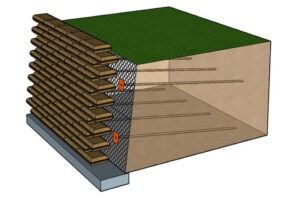
A retaining wall between 1m and 12m can be supported using soil nails. The face of the wall can be clad with a segmental block wall, earth bags or gabion baskets. The primary design constraint is the soil type.
Retaining wall repairs

Failed masonry, concrete and timber crib walls can be repaired using soil nails. The main benefit is that the existing wall can remain in place.
Slope stabilisation
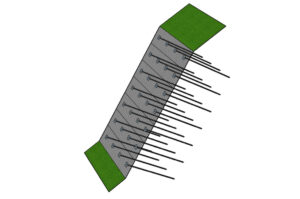
Soil nails are used in slope stabilisation. A geotechnical mat or steel mesh is placed over the slope and held down with soil nails.
Soil nail design
GEO5 or similar software is used to design soil nail retaining walls. The design criteria include:
Soil properties
Soil type, strength, and groundwater conditions influence the nail design.
Surcharge loads
The use of the retained soil, for example, a flat garden, a sloping garden or field, a car park, or a highway.
Type of nail
Steel rod, self-drilling, anchor system
Nail spacing
The horizontal and vertical spacing between nails, crucial for load distribution and structural integrity.
Nail length
The length of the nail determines its embedment depth in the soil, impacting its stability and load-carrying capacity.
Nail diameter
A larger diameter nail will have a higher load-carrying capacity, but also requires larger grouted holes
Nail inclination
The angle of the nail relative to the ground surface affects the shear resistance and load transfer mechanism.
Soil nail design considerations
Site investigation
Thorough site investigation is crucial to determine accurate soil properties and conditions. If this is not possible, a test soil nail can be installed and tested.
Deformation analysis
In some cases, a deformation analysis may be necessary to ensure that the anticipated deformations of the soil-nailed system are within acceptable limits.
Construction techniques
Proper installation techniques are vital for the effectiveness of the soil nailing system.
Gallery of Soil nail retaining wall


Compare prices of retaining wall types
Which retaining wall type is the most economical to build? We have written a free guide on retaining wall price comparisons. The guide details the different types of retaining walls and gives you a price estimate of each type to compare.
Retaining wall price comparison guideSoil nail retaining wall design service
The design of a retaining wall requires knowledge of the retaining material, the water table, the ground bearing capacity and any site constraints. The design requires a ground investigation and a structural engineer to ensure the design is fit for purpose.
We offer a full design service from carrying out the ground investigation to final working drawings.
Learn about our retaining wall design serviceOther types of walls
FAQs about Soil nail retaining wall
The cost of soil nailing is from £250 per m2 to £500 per m2 depending on the soil type, bar length, bar material, scale of project and many more variables. Tell us about your project and we can give you a better idea.
The above costs are for the soil nailing only, add £200 per m2 ro add a covering of segmental wall blocks, gabion baskets or earthbags.
The cheapest type of soil nail is a galvanised steel re-bar. The bar type will depend on the life span requirement, wall height, surcharge loads, soil type.
Soil nails are installed by specialist contractor with geotechnical experience. It is important to understand soils.