
Retaining Wall Cost and Type Comparison Guide

Opening Introduction
Retaining wall cost and retaining wall types. Choosing the right retaining wall type and is not simply about finding the cheapest option.
The best retaining wall solution depends on several factors including:
- Retained height
- Ground conditions
- Excavation restrictions
- Access limitations
- Appearance requirements
- Structural loading
- Drainage
- Buildability
- Long-term maintenance
- Overall construction budget
Some retaining wall systems are ideal for domestic gardens, while others are better suited for commercial developments, highways, flood defence projects, or constrained urban sites.
This guide compares the most common retaining wall types used in the UK and explains:
- Typical costs
- Advantages and disadvantages
- Excavation requirements
- Construction methods
- Ideal applications
- Buildability considerations
Retaining Wall Type Comparison Table
The cost variations below are based on height; the higher the wall, the higher the cost. The price range is from 1 m to 5 m in height.
| Retaining Wall Type | Typical Cost | Best For | Excavation Profile | Appearance | Buildability |
|---|---|---|---|---|---|
| Gabion Basket Wall | £300-£600 | Domestic & rural | Medium | Natural stone finish | Easy |
| Segmental Block Wall | £400-£800 | Gardens & landscaping | Medium | High aesthetic appeal | Easy |
| Reinforced Concrete Wall | £500-£900 | Heavy loading | Large | Modern/engineered | Complex |
| King Post Wall | £400-£750 | Tight boundaries | Very small | Industrial/contemporary | Specialist |
| Gravity Wall | £400-£750 | Low-height walls | Large | Variable | Moderate |
| Cantilever Wall | £450-£850 | Commercial projects | Large | Engineered appearance | Complex |
| Sleeper Retaining Wall | £300-£600 | Small domestic walls | Small | Rustic | Easy |
| Stepoc Wall | £450-750 | Flood defence & structural | Medium | Rendered/contemporary | Moderate |
| Sheet Pile Wall | £600-£1000 | Waterfront & tight access | Very small | Industrial | Specialist |
| Reinforced Earth Wall | £300-£700 | Infrastructure projects | Large | High-end engineered | Complex |
What Affects Retaining Wall Costs?
Main Cost Factors: Before comparing retaining wall systems, it is important to understand what drives retaining wall costs.
Retained Height: Higher walls require:
- Larger foundations
- Increased reinforcement
- Deeper embedment
- Additional structural design
Ground Conditions: Poor ground conditions may require:
- Deeper foundations
- Piling
- Specialist drainage
- Ground improvement
Surcharge Loads: Additional loading from:
- Vehicles
- Buildings
- Slopes
- Driveways
- Highways
These surcharge loads can significantly increase structural requirements.
Excavation Requirements: Excavation is often a major cost driver. Some retaining wall systems require substantial excavation behind the wall, while others require very little.
Access Restrictions: Limited access can increase:
- Labour costs
- Construction duration
- Material handling costs
Drainage: Proper retaining wall drainage is critical for reducing hydrostatic pressure and preventing wall failure.
Cheapest Retaining Wall Types
Gabion Basket Retaining Walls
Gabion basket retaining walls are often one of the most cost-effective retaining wall solutions.

Advantages
- Relatively low material cost
- Good drainage performance
- Quick installation
- Flexible appearance
- Environmentally friendly
Disadvantages
- Require space
- Large footprint
- Not ideal for very high walls
- Appearance may not suit all developments
Typical Applications
- Domestic gardens
- Rural projects
- Landscaping
- Erosion control
Typical Cost
- Approximately £300–£600er m² depending on height and access.
Best Retaining Wall for Tight Boundaries
King Post Retaining Walls
King post retaining walls are highly effective where excavation space is limited.
One of the biggest advantages is the extremely small excavation profile compared to traditional reinforced concrete retaining walls.

Advantages
- Minimal excavation
- Protects tree roots
- Excellent for boundaries
- Fast installation
- Effective for heights up to approximately 3.5m
Disadvantages
- Requires specialist plant
- Drilling required
- Less suitable in made-up ground or shallow bedrock
Best Applications
- Tight urban sites
- Boundary retaining walls
- Restricted access projects
- Slope stabilisation
Typical Cost
- approximately £400–£750 per m² depending on loading and ground conditions
Best Looking Retaining Wall Types
Segmental Block Retaining Walls
Segmental retaining walls are popular because they combine structural performance with attractive finishes.

Advantages
- Aesthetically attractive
- Many colours and finishes
- Flexible layouts
- Ideal for landscaping
Disadvantages
- Can become expensive at larger heights
- Requires proper drainage and reinforcement
Best Applications
- Domestic gardens
- Housing developments
- Landscaping projects
Typical Cost
- Approximately £400–£800 per m²
Best Retaining Wall for Flood Defence
Stepoc Retaining Walls
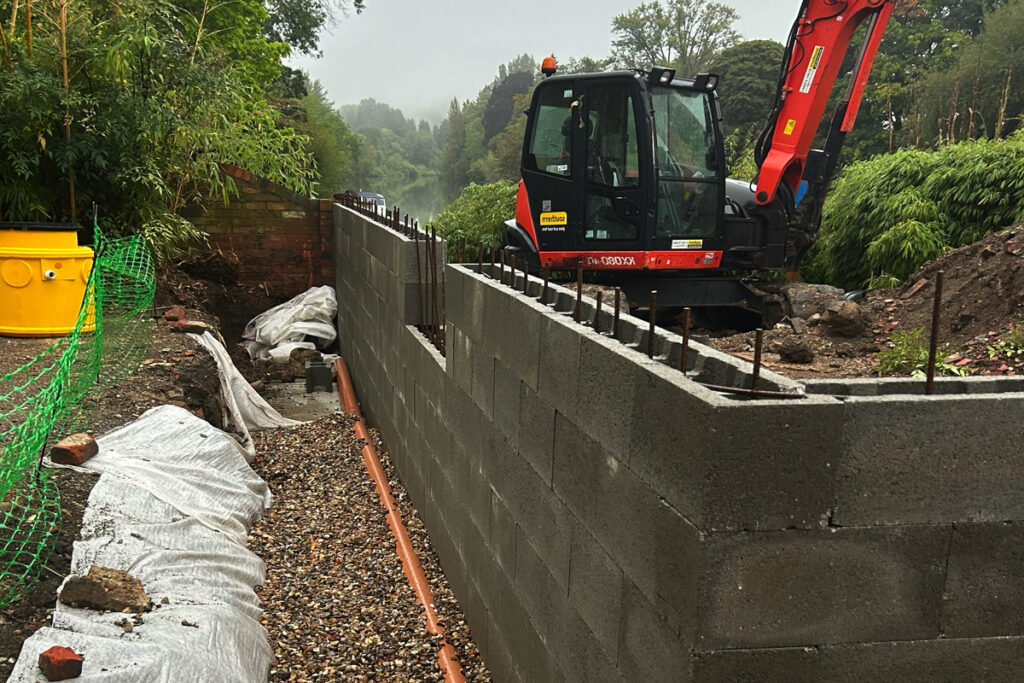
Stepoc retaining walls are increasingly used for flood defence and structural retaining applications.
Advantages
- Reinforced concrete core
- Excellent structural strength
- Good waterproofing potential
- Suitable for rendered finishes
Disadvantages
- Higher labour requirement
- Requires reinforcement and concrete filling
Best Applications
- Flood defence
- Basement construction
- Commercial developments
- Structural retaining walls
Typical Cost
- Approximately £450–£750 per m²
Which Retaining Wall Is Best?
The best retaining wall depends entirely on the project constraints.
If low cost is the priority:
- Gabion basket walls
- Sleeper retaining walls
If appearance is the priority:
- Segmental block retaining walls
If excavation space is limited:
- King post retaining walls
- Sheet pile walls
If flood defence is important:
- Stepoc walls
- Reinforced concrete walls
If heavy loading is present:
- Reinforced concrete walls
- Cantilever retaining walls
How to Choose the Right Retaining Wall
The most economical retaining wall is usually the solution that balances:
- Excavation
- Structural performance
- Labour
- Access
- Buildability
- Long-term maintenance
A retaining wall that appears cheaper initially may become significantly more expensive once:
- Excavation
- Drainage
- Plant access
- Reinforcement
- Temporary works
- Foundation requirements are fully considered.
Retaining Wall Design Support
Choosing the wrong retaining wall type can dramatically increase project costs.
Professional retaining wall advice can help:
- Reduce excavation
- Improve buildability
- Reduce construction cost
- Simplify drainage
- Avoid overdesign
- Improve long-term performance
Retaining wall support
It can be difficult to select the right solution for your needs. If you wish to submit an enquiry or are not sure and need support, complete the form below, you can use this form to upload images or documents as well. We will get in touch within a few hours.
FAQ Section
What is the cheapest retaining wall type?
Gabion basket walls and timber sleeper retaining walls are often among the cheapest retaining wall solutions for smaller domestic projects. However, the cheapest option depends on retained height, ground conditions, excavation, drainage, access and loading requirements.
Which retaining wall requires the least excavation?
King post retaining walls and sheet pile walls usually require the smallest excavation profile. They are often suitable for tight boundaries, restricted access areas and sites where large-scale excavation behind the wall is not practical.
Do retaining walls require drainage?
Yes. Most retaining walls require suitable drainage to reduce hydrostatic pressure behind the wall. Poor drainage is one of the most common causes of retaining wall movement, cracking, bulging and failure.
Which retaining wall is best for gardens?
Segmental block retaining walls, gabion baskets and sleeper walls are popular choices for gardens. Segmental block walls are often preferred where appearance is important, while gabion and sleeper walls can be more cost-effective for smaller landscaping projects.
How much does a retaining wall cost in the UK?
Retaining wall costs in the UK vary significantly depending on wall type, retained height, ground conditions, surcharge loads, excavation, drainage, access and finish. Simple low-height walls may be relatively inexpensive, while engineered retaining walls with structural loading or poor ground conditions can cost considerably more.
Do I need a structural engineer for a retaining wall?
A structural engineer is recommended for retaining walls where height, soil pressure, surcharge loading, nearby buildings, roads, driveways or poor ground conditions are involved. Structural design helps ensure the wall is safe, stable and suitable for the site conditions.
What affects the cost of a retaining wall?
The main factors affecting retaining wall cost include retained height, wall type, ground conditions, foundation requirements, drainage, access, excavation, labour, material costs, structural design requirements and any surcharge loads from vehicles, buildings or sloping ground.
Which retaining wall type is best for tight boundaries?
King post retaining walls are often one of the best options for tight boundaries because they have a small excavation profile and can be constructed close to site boundaries. Sheet pile walls may also be suitable where very limited excavation is possible.
Are gabion retaining walls cheaper than concrete retaining walls?
Gabion retaining walls are often cheaper than reinforced concrete retaining walls for lower-height or landscaping projects. However, reinforced concrete walls may be more suitable where high loads, limited space, formal finishes or more complex structural requirements are involved.
What is the best retaining wall type?
The best retaining wall type depends on the project. Gabion walls can be cost-effective, segmental block walls are attractive for landscaping, king post walls are useful for tight spaces, Stepoc and reinforced concrete walls suit structural applications, and sheet pile walls are useful where excavation is very restricted.

- Author:
- Bob Evans
- Job Title:
- Founder
- Company:
- Retaining Wall Solutions
- Last updated:
- July 20, 2026, 11:31 pm

